
OPINION
Muñoz the American
I borrow the title from the excellent book by my friend Gregorio Igartúa de la Rosa, Muñoz el americano, which correctly cites the many times that the founder of the PPD defended the values of the people, which includes the institutions of the federal government and our citizenship: “The moral and profound meaning of the citizenship of the United States is that it contains an inherent devotion to freedom, the consecration of democracy, and profound respect for the dignity of the human being.”
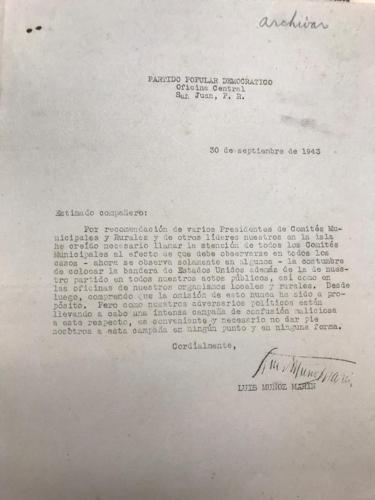
On September 30, 1943, at the height of the Second World War, he wrote a letter that has gone unnoticed: “… I have thought it necessary to call the attention of all Municipal Committees to the effect that in all cases—now it is observed only in some—the custom of placing the flag of the United States in addition to that of our party in all our public events, as well as in local and rural organizations, should be observed.”
Since the 1940s, Luis Muñoz Marín’s political thinking has been one of complete rejection of Puerto Rico’s separation from the United States. During the Constitutional Convention, he was emphatic in defending the values of the people and the legal and political figures representing the federal government that coexist here. He had no qualms about saying at the end of his work that: “We are not pro-American, we are American citizens. We are not protected by American citizenship. We carry American citizenship within us.”
We must emphasize that Luis Muñoz Marín was the president of the Preamble Commission of the Constitutional Convention. Therefore, he also has a father-son relationship with the lapidary sentences of said preamble: “We consider determining factors in our life the citizenship of the United States of America and the aspiration to continually enrich our democratic heritage in the individual and collective enjoyment of its rights and prerogatives; loyalty to the postulates of the Federal Constitution; the coexistence in Puerto Rico of the two great cultures of the American hemisphere.” With this, biculturalism acquired constitutional character.
With the Commonwealth Constitution, Puerto Rico began to operate as a state in internal affairs. Although the United States Congress still has control by virtue of Article IV, Section 3, Clause 2 of the Constitution—the well-known territorial clause—there was a change at the internal level. It was the first time in history that Congress legislated for one of its territories to have a constitution with a bill of rights and a republican government.
Some jurists called this change the “embryonic state.” (See Efraín Rivera Pérez, Puerto Rico – three paths to the future: legal analysis). In other words, a foretaste of statehood. For his part, Rafael Hernández Colón, in his book Estado Libre Asociado: Naturaleza y Desarrollo, understands that what was achieved in 1952 fully complies with the requirements of an enabling act for the formal entry of Puerto Rico as a state of the Union.
On the fourth anniversary of the “law of bases” —as José Trías Monge sometimes called the ELA—, the poet of the state-liberalism gave a speech in evident homage to the citizenship of the United States. With this, Luis Muñoz Marín reaffirmed himself as the greatest defender of American citizenship in the entire history of Puerto Rico. I believe that he and Rafael Hernández Colón —more than any leader of the PNP— are the ones who have defended it the most. His phrase “diversity within unity,” which is the reality of the American nation, was brilliant, and it explains the phenomenon of the love of Puerto Ricans for this legal figure with characteristics of cultural value. It is a metaphor that can be extrapolated, without problems, to the alternative of statehood.
In 1960, during congressional hearings to amend the United States Constitution so that American citizens in Washington DC could vote for their president, Luis Muñoz Marín stated that every citizen should have the right to vote regardless of their place of residence. He also spoke out for the 1967 plebiscite.
At the end of their days, he and Fernós stipulated that because they were American citizens, the United States was also our country. (See Héctor Luis Acevedo, Ed., Dr. Antonio Fernós Isern: from doctor to constituent). A true truth, since our nation begins in the Caribbean islands and ends in the middle of the Pacific Ocean, although the current leaders of their party do not recognize it, since they threw the political ideology of their founding father into the trash.
- Facebook Twitter WhatsApp E-mail Print Copy article link
- Tags
- Second World War Luis Munoz Marin Municipal Committees

Mario Ramos Mendez
Mario Ramos, HistorianFollow this search
Luis Muñoz Rivera – Wikipedia, la enciclopedia libre

Wikipediahttps://es.wikipedia.org › wiki › L…

Luis Muñoz Rivera (Barranquitas, 17 de julio de 1859 – San Juan Puerto Rico, 15 de noviembre de 1916) fue un poeta, orador, periodista y político nacido en …
People also ask
¿Qué hizo Luis Muñoz Rivera por Puerto Rico?
¿Por qué era conocido Luis Muñoz Rivera?
¿Qué año murió Luis Muñoz Marín?
¿Dónde enterraron a Luis Muñoz Marín?
Luis Muñoz Rivera

Wikipediahttps://en.wikipedia.org › wiki › Luis_Muñoz_Rivera
Luis Muñoz Rivera (July 17, 1859 – November 15, 1916) was a Puerto Rican poet, journalist and politician. He was a major figure in the struggle for …
Luis Muñoz Rivera

rafaelhernandezcolon.orghttps://rafaelhernandezcolon.org › BiografiaLMR
Luis Muñoz Rivera, nació en Barranquitas, Puerto Rico el 17 de julio de 1859. En 1882 se dió a conocer como poeta al publicar en el periódico ponceño El Pueblo …
Luis Muñoz Rivera – EnciclopediaPR

Enciclopedia de Puerto Ricohttps://enciclopediapr.org › content
Jun 21, 2021 — Nació el 17 de julio de 1859. Sus padres fueron Luis Muñoz Barrios y Monserrate Rivera Vázquez. A sus 28 años, en 1887, fue representante por …
Luis Muñoz Rivera | Puerto Rican, Politician, Journalist

Britannicahttps://www.britannica.com › … › Islands & Archipelagos
Jul 13, 2024 — Luis Muñoz Rivera was a statesman, publisher, and patriot who devoted his life to obtaining Puerto Rico’s autonomy, first from Spain and …
Luis Muñoz Rivera – Barranquitas

barranquitaspr.nethttps://www.barranquitaspr.net › lui…
Fue político de ideas liberales, periodistas y poeta. Nace en Barranquitas, P. R., el 17 de julio de 1859. Fueron sus padres Luis Muñoz Barrios y Monserrate …
Luis Muñoz Rivera (1859–1916) | 1898

Smithsonian Institutionhttps://1898exhibition.si.edu › node
Luis Muñoz Rivera fue una de las voces principales del Partido Autonomista de Puerto Rico, que aspiraba a un gobierno independiente bajo el dominio español …
Luis Muñoz Rivera – El Último Gran Autonomista …

Salón Boricuahttps://www.salonboricua.com › lu…
Luis Muñoz Rivera (1859-1916), político, periodista, poeta y orador puertorriqueño. Nació el 17 de julio en Barranquitas, Puerto Rico. Fue voz principal del …
Luis Muñoz Rivera – World of 1898: International …

Library of Congress Research Guides (.gov)https://guides.loc.gov › world-of-1898 › luis-munoz-ri…
Born in Barranquitas, Puerto Rico, Muñoz Rivera studied in local schools and entered politics in 1887. He became a leader of the Autonomist Party and in 1890 …
Biografia de Luis Muñoz Rivera

Biografias y Vidas .comhttps://www.biografiasyvidas.com › …
(Barranquitas, 1859 – Santurce, 1916) Escritor y político puertorriqueño. Luis Muñoz Rivera luchó incansablemente a lo largo de su vida por obtener la …


 Estado51prusa's Blog