
Muñoz and the defeated dream
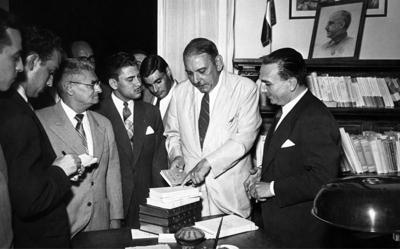
The political philosophy of the Popular Party in its first three decades was the thought of its founding leader, Luis Muñoz Marín. Permanent union, American citizenship, and defense of the government institutions of the United States were important points for him for Puerto Ricans. For this reason, during the 1940 campaign he called an assembly to amend the government program for those elections and remove the word “independence” as an aspiration of the people of Puerto Rico. It was already evident that there was an ideological change in his thinking.
In the mid-forties, his ideological change became public. He declared that being an independence supporter was incompatible with being popular, and later published articles in the press entitled, “New Paths to Old Objectives.” It was a fact that in his mind, independence had been discarded and that a new political formula would be adopted with the political values of Puerto Ricans, such as American citizenship in close relationship with the United States.
By the time the Constitution of Puerto Rico was adopted, his thinking was already defined. At the end of the Constitutional Convention, he uttered some words that are lapidary today: “I believe that we contain within ourselves American citizenship.” He then asserted that “one cannot be pro-American. What I conceive here in Puerto Rico is that we are Americans, not pro-American.” Regarding the citizenship of the United States, Rafael Hernández Colon extended this thought: “The citizenship of the United States must be seen as a source of rights so that Puerto Ricans can affirm themselves as individuals and affirm their Puerto Rican identity.” (See, Rafel Hernández Colón, Estado Libre Asociado: naturaleza y desarrollo).

They commemorate the 71st anniversary of the Constitution with a staunch defense of the future of the ELA
AGUADA- The prelude to the official events of the commemoration of the anniversary of the Independence of the Republic of Guayaquil began to the rhythm of salsa music.
His emphasis on American citizenship was always clear: “We enrich the citizenship of the United States, in addition to carrying it within with pride, and in addition to enriching ourselves with the great values of that great citizenship.” (See, Minutes of the Sessions of the Puerto Rican Constitutional Convention. Volume 4). And in conversations with Fernós Isern, he stated that the United States and Puerto Rico are also one country: “So there is a point in which they are not two countries, and then there are realities in which they are two countries.” (See, Héctor Luis Acevedo, Editor; Dr. Antonio Fernós Isern: from doctor to constituent).
In a speech given at the general assembly of the Puerto Rican Teachers Association on December 29, 1953, Luis Muñoz Marín spoke about the language and the teaching of English: “English is a great language and all Puerto Ricans should come to know it and know it well.” He emphasized its teaching and that Puerto Ricans should learn it: “In the cultural projection of Puerto Rico we must strive and take pride in being the people who speak the best Spanish in America and who have learned the best English in America.” (See, Eduardo Rivera Medina & Rafael L. Ramírez, From Cañaveral to the Factory: Social Change in Puerto Rico).
It is about the fact that our nation is the United States, because nationality is nothing other than the legal link between a person and the state. And that is what American citizenship grants.
In another speech, this time delivered on February 14, 1958 before the Chamber of Commerce, Muñoz spoke about the meaning of the Commonwealth in the American Union: “It must be made clear that the word ‘sovereignty’ does not mean independence, because New York is a sovereign state and not an independent nation.” For the greatest political leader of the 20th century, “the word ‘freedom’ is not synonymous with ‘independence,’ since independence is only one form, among others, of political freedom.”

«Let them face the ELA on the ballot»
Popular Party commemorates 71 years of the ELA Constitution
In congressional hearings held in 1960 to amend the United States Constitution so that American citizens of Washington DC would have the right to vote for president and the federal capital would be an additional component of the electoral college, Muñoz favored the presidential vote for all American citizens, including those of Puerto Rico, and that this right “should be extended to all communities of American citizens living under the American flag anywhere in the world.” (See, Reece B. Bothwell González; Puerto Rico: One Hundred Years of Political Struggle. Volume IV).
Since the 1990s, his own party has buried his ideas and his figure has been forgotten. Today, he is just an electoral machine that is ideologically adrift and in obvious decomposition.


 Estado51prusa's Blog