
Read Mario Ramos Méndez’s
OPINION
Abnormal changes
Read Mario Ramos Méndez’s opinion column
- Mario Ramos Mendez, historian 05/07/2024 Updated 10 years ago 6 hours Comments Facebook Twitter WhatsApp E-mail
There are no communists or marxists in our ideas. Our political philosophy is representative of democracy and social justice in a well-planned economy. -Fidel Castro.
When the work for the adoption of the Constitution of the Commonwealth was underway between 1950 and 1952, the Puerto Rican Independence Party repudiated and boycotted it, saying that it did not guarantee any change in the centuries-old political condition of Puerto Ricans. To this could be added the comments of Miguel Ángel García Méndez that with this Law of Bases we would have the category of “perfumed colony.” Later, the statehood leader agreed to support it when Luis Muñoz Marín accepted the suggestions for the Preamble.
That year’s elections were the first held under the new Constitution, and the pipiolo independentists obtained 19% of the votes and elected several legislators by virtue of the new constitutional reality that guaranteed them seats in the House of Representatives and the Senate by activating what is known as the minority law.
For the 1967 plebiscite, held on July 23, two parties boycotted it: the Republican Statehood Party and the Puerto Rican Independence Party. Statehood and independence were orphaned. The first was represented by the Association of United Statesmen, a group that originated in the Republican assembly at the San Jerónimo Hotel, where a group united with the position of Luis A. Ferré followed him to defend it in the consultation. García Méndez opposed it, stating that it was a “spurious plebiscite” and the closest thing to “a sympathy contest.”
Independence was defended by a small group called Fondo para la República, led by university professor Héctor Álvarez Silva. The reasons for the pipiolos boycotting it was because this electoral exercise was “a farce.”
However, when the New Progressive Party came to power, its determination to participate in every plebiscite event was unwavering. They never abstained or stopped defending their ideal. The same happened with the Puerto Rican Independence Party since Rubén Berríos Martínez became its president in the late 1960s. Both parties promoted and supported the holding of plebiscites and have done so until as recently as 2020.
In 1989, a process began in the United States Senate to address the issue of Puerto Rico’s political status. The three political parties of Puerto Rico registered at that time participated. Independent of the electoral percentages of each one, ideologically the Puerto Rican Independence Party was seen as the third part of everything, and its participation was decisive and committed to its ideal of independence. The other pro-independence groups were forced to revolve around the pipiolos, who were the most popular by far.
When Pedro Rosselló won the governorship, he kept his promise to hold a plebiscite. The Independentist Party got fully involved and its campaign was intense. On radio, in the press and on television, and in each municipality, its cardinal principle was to defend its ideal. Rubén Berríos was consistent in this. Some of the independentist groups opposed it, but others followed the tone of the pipiolos who were in line with the philosophy of their leader.
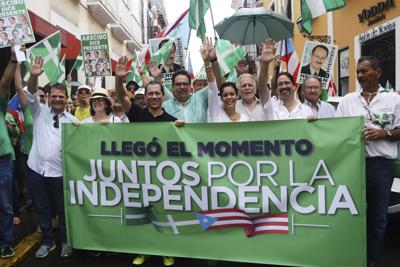
The same thing happened in the 1998 plebiscite. Pipiolo independentists took to the streets to defend independence. The following year, Vieques came, where Rubén Berríos carried out honest, and with intellectual integrity, civil disobedience, being the true leader of that struggle and the true hero. Others took pon and their only gesture of combat was to jump a fence and be covered by the press with greater enthusiasm than the pipiolos.
There is a book about the Pipiola struggle that is a must-read. Its author, a fan of art, poetry, literature, painting and music, wrote a text that portrays those years very well, since he was one of the protagonists: Chronicle of a Disobedient by Otho Rosa.
However, things have changed now. Their traditional love for the left of Nicolás Maduro, Daniel Ortega and Castro’s Cuba has been camouflaged by the ambition to reach power, which has become something more attractive and appealing to them than ideology. Juan Dalmau, Ana Irma Rivera Lacén, Mariana Nogales and Rafael Bernabe have hung up their independence on the back burner. They have done so to reach power, which is nothing other than deceiving the people and then seeking what the people themselves, whom they claim to defend, have repudiated in every election and plebiscite up to this day.


 Estado51prusa's Blog